
Florida Homestead Exemption: How to Qualify and Save on Property Taxes
One of the biggest financial perks of owning your primary home in Florida is the homestead exemption. It can lower your property tax bill right away and, through the Save Our Homes cap, limit how fast your assessed value grows in the years that follow. Yet many new owners miss the filing deadline or never apply at all.
This guide explains how the Florida homestead exemption works, who qualifies, and how to file. If you are still shopping, our guide on how to buy a house in Florida covers the full purchase process.
What Is the Florida Homestead Exemption?
The homestead exemption reduces the taxable value of your primary residence. Under the Florida Constitution and statutes, qualifying homeowners receive an exemption on the first $25,000 of assessed value that applies to all property taxes, plus an additional exemption of up to $25,000 on assessed value between $50,000 and $75,000 that does not apply to school district taxes. Together these can reduce your taxable value by as much as $50,000 for non-school taxes, and the dollar savings depend on your local millage rates.
The exemption is also tied to a powerful long-term protection: the Save Our Homes assessment cap.
The Save Our Homes Cap
After your first homestead year, the assessed value of your home generally cannot increase by more than 3 percent per year or the percentage change in the Consumer Price Index, whichever is lower. Meanwhile, market values in Florida can rise faster. Over time, a homesteaded home can have an assessed value well below its market value, which means a lower tax bill than a similar neighbor who bought recently.
The flip side is important for buyers: when a home sells, its assessed value typically resets to market value for the new owner. That is why you should never estimate your future taxes by looking at the seller’s current bill. Ask your agent to help you estimate taxes using the likely purchase price and local millage rates.
Who Qualifies?
To qualify, you generally must meet these basic conditions:
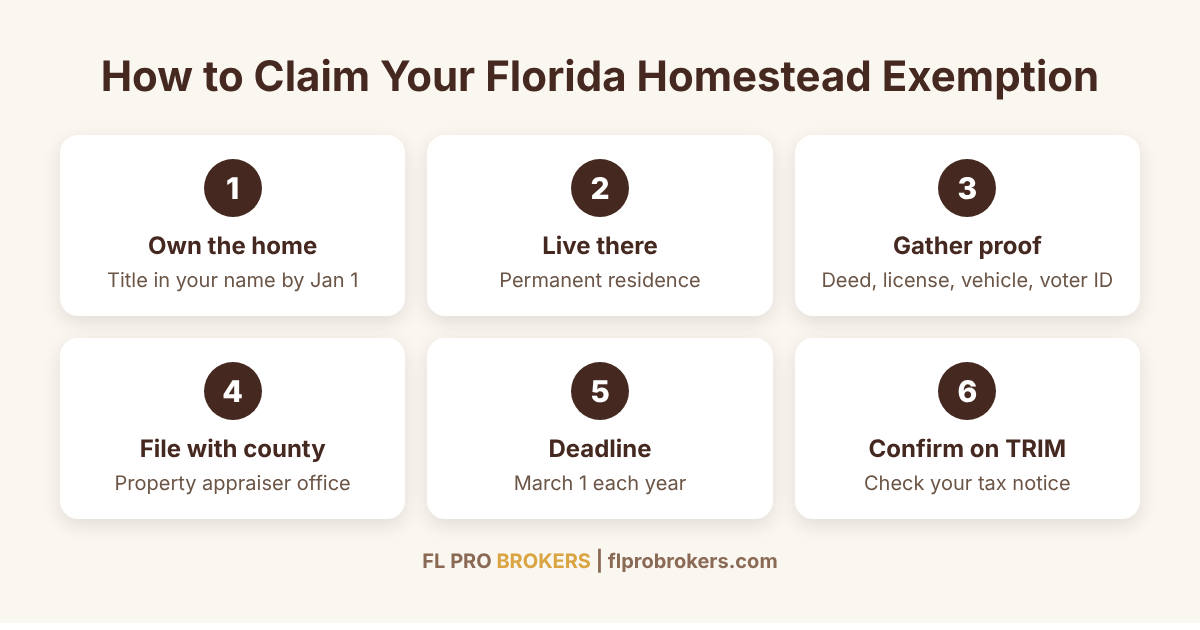
- Ownership: you hold legal or equitable title to the home as of January 1 of the tax year.
- Residence: the property is your permanent residence as of January 1, and you intend to live there.
- Florida residency: you can show you are a Florida resident, typically through a Florida driver license or ID, vehicle registration, and voter registration.
- One homestead: you cannot claim homestead on two properties, or claim a similar exemption in another state.
Second homes, vacation homes, and rental properties do not qualify.
How and When to Apply
You apply with the property appraiser in the county where the home is located. Most counties accept applications online, by mail, or in person. Bring or upload documents such as your recorded deed or closing statement, Florida driver license or ID, vehicle registration, and voter registration, plus Social Security numbers for the owners and their spouses.
The deadline is March 1 for the tax year, and the date can shift slightly when March 1 falls on a weekend. If you buy a home in 2026, for example, you would typically apply in early 2027 for the 2027 tax year, once you owned and lived in the home on January 1, 2027. Late filing may be possible in limited circumstances, so do not rely on it. Mark the deadline on your calendar the day you close.
Additional Exemptions Worth Checking
Florida offers other exemptions on top of or alongside homestead, and eligibility depends on your circumstances. They may include exemptions for seniors with limited income, veterans and service members, surviving spouses, people with certain disabilities, and first responders. Details and income limits are set by state law and local governments, so check your county property appraiser’s website for what is currently offered.
Portability: Taking Your Savings With You
If you sell your homesteaded property and buy a new Florida home, you may be able to transfer part of your accumulated Save Our Homes benefit, up to a statutory maximum, to the new home. This is called portability. It generally requires that you establish a new homestead within a limited window after you gave up the old one, usually within two January 1 dates. If you are moving up or down in price, portability can lower your new tax bill, so ask your property appraiser to calculate it before you finalize your purchase.
Common Mistakes to Avoid
First, missing the deadline: the exemption does not apply automatically, so file even if the previous owner had it. Second, assuming taxes will stay the same after you buy: reassessment at market value typically happens, and your first full bill may be higher than the seller’s. Third, keeping homestead after you move out or rent the home: this can trigger back taxes and penalties, so notify the property appraiser if your status changes. Fourth, forgetting the TRIM notice: the Truth in Millage notice you receive each summer shows proposed taxes and your window to challenge your value.
A Note on Possible Changes
Property tax policy is an active topic in Florida, and lawmakers have debated proposals that could change exemptions and how homestead property is taxed. Before you rely on a specific figure, confirm the current rules with your county property appraiser or tax collector.
A Quick Example of the Savings
Suppose your local combined millage rate is 18 mills, meaning $18 of tax per $1,000 of taxable value. An exemption of up to $50,000 on non-school taxes could reduce your annual bill by several hundred dollars, and the Save Our Homes cap can add to those savings every year as market values climb. The exact figure depends on your county, city, and school rates, so use your county property appraiser’s tax estimator for a realistic number. Savings compound over time, which is why filing in your first eligible year is so important, and why long-term owners often pay notably less than recent buyers of similar homes.
Frequently Asked Questions
Does the homestead exemption apply automatically when I buy a house?
No. You must apply with your county property appraiser, even if the home was previously homesteaded.
Can I get homestead if I close after January 1?
Not for that year. You generally need to own and occupy the home as your permanent residence on January 1, so you would apply the following year.
Does homestead lower my insurance?
No. It affects property taxes, not homeowners insurance. For insurance topics, see our Florida homeowners insurance guide.
Plan Your Taxes Before You Buy
Understanding property taxes helps you shop smarter. Reach out to FL Pro Brokers and we can help you estimate costs for homes you are considering.
This article is for general information and is not legal, tax, or financial advice. Confirm current rules and deadlines with your county property appraiser.