Florida Closing Costs: What Buyers and Sellers Really Pay
Closing costs are the fees and prepaid items due when a real estate sale becomes official. In Florida, they are easy to underestimate because several charges, including documentary stamp taxes and title insurance, are specific to the state. This guide explains what closing costs are, who typically pays each one, and how to keep them under control.
If you are still planning your purchase, our overview of how to buy a house in Florida shows where closing fits into the full process.
How Much Are Closing Costs in Florida?
A common rule of thumb is that buyers should budget roughly 2 to 5 percent of the purchase price for closing costs, though the real number depends on your loan, insurance, and local customs. Sellers often pay a different set of costs, with agent compensation and doc stamps usually the largest. Because every deal is different, ask your lender for a Loan Estimate and your title company for a cost sheet early in the process.
Buyer Closing Costs in Florida
Lender and loan fees
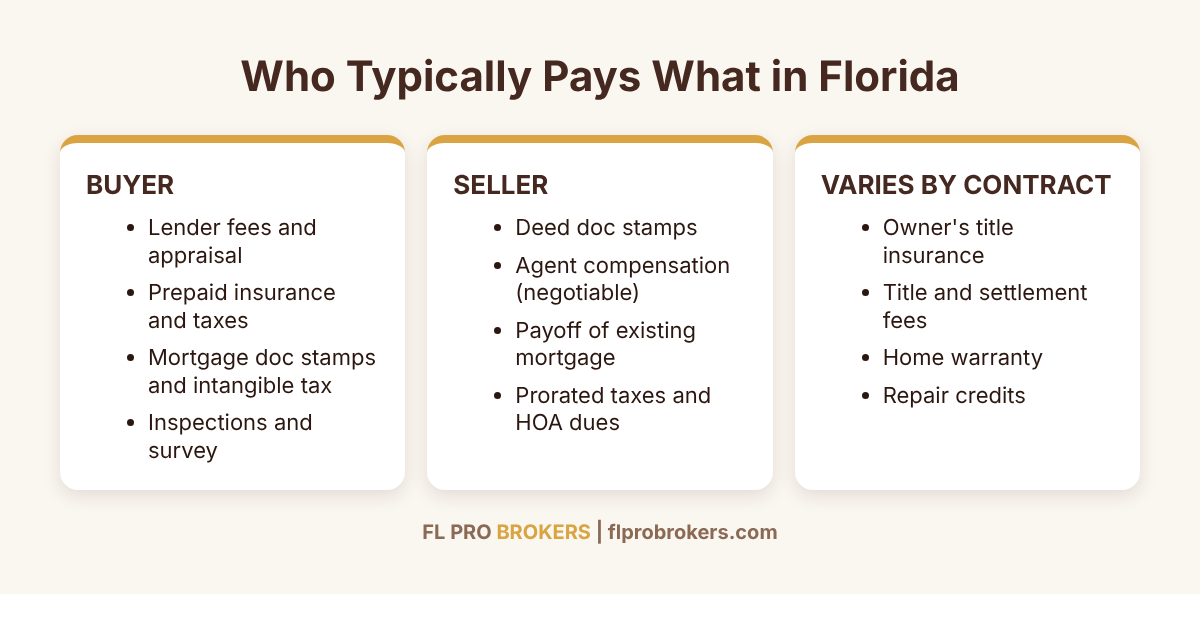
Financed buyers pay for the loan itself: origination or underwriting fees, credit report, appraisal, and sometimes discount points to buy down the interest rate. Compare Loan Estimates from several lenders, since these fees can differ even when interest rates look similar.
Florida mortgage taxes
When you finance a purchase in Florida, the state charges documentary stamp tax on the promissory note, historically 35 cents per $100 of the loan amount, plus a nonrecurring intangible tax on the mortgage of 0.2 percent of the loan amount. These taxes apply to the loan, so cash buyers do not pay them. Rates are set by statute, so confirm current figures with your title company.
Prepaids and escrows
Lenders usually require you to prepay homeowners insurance for the first year and set up an escrow cushion for property taxes and insurance. This can be a surprisingly large line item in Florida because of insurance premiums, and it is one reason to get insurance quotes early. See our homeowners insurance guide.
Title, settlement, and recording fees
The title company charges to search records, issue title insurance, and handle the closing. Title insurance premiums in Florida are regulated by the state, but other settlement fees are not, so it pays to compare. You will also pay recording fees to the county for the deed and mortgage.
Inspections and survey
Inspections are paid upfront rather than at the closing table, but they are part of your total cash needs. Florida buyers often pay for a general inspection, and sometimes for roof, wind mitigation, termite, and sewer inspections. A survey may be required by your lender or title insurer, especially for properties with pools, fences, or boundary questions.
Seller Closing Costs in Florida
Documentary stamps on the deed
Florida levies documentary stamp tax on deeds at 70 cents per $100 of the sale price in most counties, and the contract customarily assigns it to the seller. On a $400,000 sale, that is about $2,800. Miami-Dade County has a different rate structure for some property types, so check locally if you are selling there.
Agent compensation
Agent commissions are negotiable. Following 2024 industry rule changes, compensation is discussed more openly between sellers, buyers, and their agents, and sellers may offer buyer-agent compensation as part of the listing terms. Ask your broker to explain the options and their effect on your net proceeds.
Mortgage payoff, taxes, and dues
If you still owe on the home, your payoff comes out of the proceeds. Property taxes and HOA or condo dues are prorated between buyer and seller as of the closing date. Sellers may also owe a transfer fee or capital improvement fee to an association, depending on the governing documents.
Repair credits and concessions
If the inspection turns up issues, you may negotiate repairs or credits. A seller concession, where the seller pays part of the buyer’s closing costs, is another common tool, and lenders limit how much can be credited depending on the loan type.
Who Pays for the Owner’s Title Insurance?
This is one of the best-known Florida quirks. Who pays for the owner’s policy varies by county and by negotiation. In some counties the seller customarily pays, while in others the buyer does. Your contract controls, so ask your agent what is typical where you are buying or selling and look at the contract line that assigns the cost.
Ways to Reduce Your Closing Costs
- Shop lenders and title companies. Fees are often negotiable and vary from one provider to the next.
- Ask for seller concessions. In slower negotiations, a seller credit toward closing may be easier to obtain than a lower price.
- Look at assistance programs. Some state and local programs help with down payment and closing costs. See Florida first-time buyer programs.
- Time your closing. Closing near the end of the month can reduce the prepaid interest you owe at closing, though your lender can confirm the effect.
- Review the Closing Disclosure. You receive it before closing; compare it to your Loan Estimate and question differences.
A Sample Closing Cost Scenario
To see how this works, imagine a $400,000 home purchased with 10 percent down and a $360,000 loan. Mortgage doc stamps at 35 cents per $100 would be about $1,260, and the intangible tax at 0.2 percent would be about $720. Add lender fees, an appraisal, title and settlement charges, recording fees, and prepaid insurance and taxes, and the total can reach the low five figures. This is only an illustration, not a quote, but it shows why a written estimate matters. Ask your lender and title company for itemized numbers early, and revisit them whenever your price, loan, or insurance quote changes.
Frequently Asked Questions
Can I roll closing costs into my mortgage?
Sometimes. Certain loans allow closing costs to be financed or covered by seller credits, but financing them raises your loan amount and monthly payment. Ask your lender what is allowed for your loan type.
Do cash buyers pay closing costs?
Yes, though fewer. Cash buyers skip lender fees and the mortgage taxes but still pay title and settlement charges, recording fees, and any inspections or surveys they choose.
When are closing costs due?
At closing, usually by wire or cashier’s check. Your title company will provide wiring instructions; always verify them by phone with a known number, since wire fraud is a real risk.
Get a Clear Picture Before You Make an Offer
The best time to understand your closing costs is before you write an offer. Talk to FL Pro Brokers for help estimating your numbers and negotiating terms that work for you.
This article is for general information and is not legal, tax, or financial advice. Tax rates and customs change; confirm current figures with your title company or attorney.